A while ago I read “The Jazz Ontology: A semantic model and large-scale RDF repositories for jazz” by Polina Proutskova et al. The title should be pretty self explanatory, but for the sake of comprehension I’ll provide a quick summary.
Essentially, the current, widespread system of music classification and archival is not fit for the unique nature of Jazz music. To find a solution they needed to find out what aspects of the music is important and semantically define them. Just as an aside, this is where, in my opinion, this paper is most susceptible to bias. Some of these values are “band lineup fluidity and importance of short melodic patterns for improvisation. This paper presents the Jazz Ontology – a semantic model that addresses these challenges.” I’m not going to go into anymore detail for the sake of being redundant in regards to the paper, you should read the paper if you have time, and focus more so on my opinions.
I want to point out the importance of having flexible cataloging systems in order to keep art at it’s purest form. Although there are many examples of Jazz players having fluidity between groups, the way streaming platforms are organized provide incentive to define a group and stick with them. Same goes for modern record labels. The popular music defines the way of storing them, leaving any other formats to try their best to fit into that box.
One example of a form of music being “oppressed” in this way would be regarding microtonal guitar music. Although there have been solutions to fitting traditional microtones within western classical notation, there are still problems trying to adapt them to modern guitar tablature. This problem is especially important in that the microtonal or fretless guitars are some of the more popular instruments in microtonal music, and modern players, especially those who don’t come from a classical or microtonal background, don’t use classical notation, for a good reason, as guitar tablature is works from guitar, but only 12edo (the chromatic scale) notes. There is no easy way to fix this, and it may even be better for fretless guitarist to treat their notation more like that of a violin or cello, but this hinderance adds on to the inaccessibility to microtonal guitar playing, stunting the development of such music and such slowly killing of this art form.
Having specialized and accessible systems for different music types is important in ensuring that these art forms aren’t diluted and fade away. Art is always changing, but the best change is that without external limitations in the way. “The Jazz Ontology” aims to help with this and are some excellent steps forward.
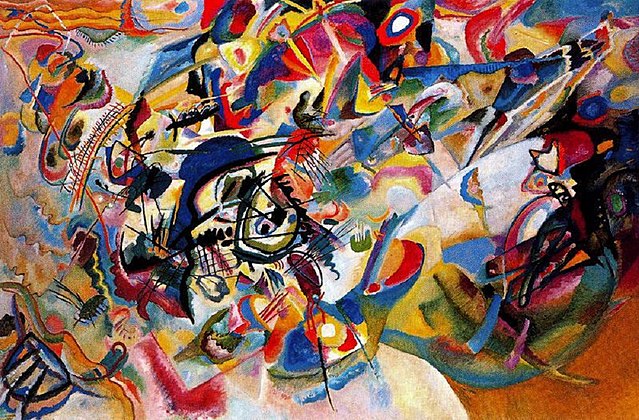
The featured image is “Composition VI” by Wassily Kandinsky
Proutskova, P., Wolff, D., Fazekas, G., Frieler, K., Höger, F., Velichkina, O., Solis, G., Weyde, T., Pfleiderer, M., Crayencour, H. C., Peeters, G., & Dixon, S. (2022). The Jazz Ontology: A semantic model and large-scale RDF repositories for jazz. Journal of Web Semantics, 74, Article 100735. https://doi.org/10.1016/j.websem.2022.100735

Leave a comment