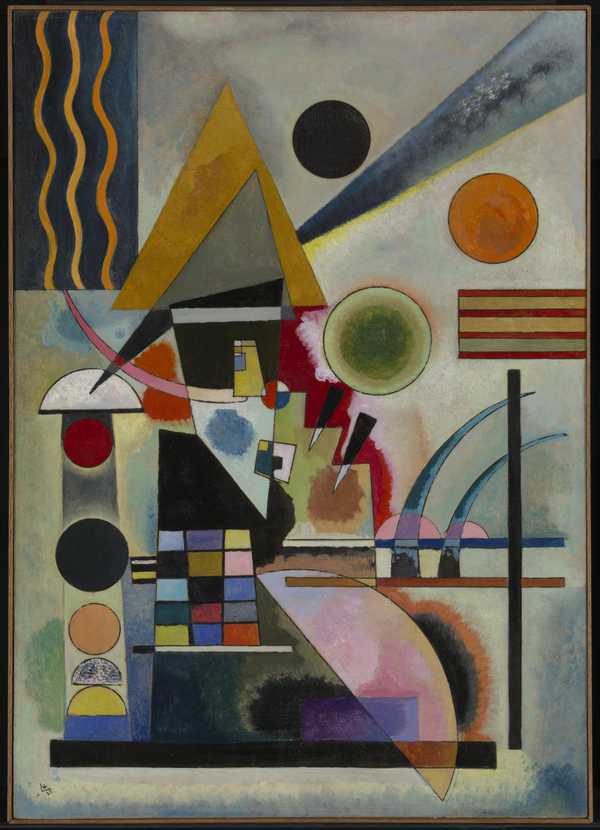
“Swinging” by Wassily Kandinsky, Oil on millboard, 1925, The Tate Gallery 1978-80: Illustrated Catalogue of Acquisitions, London
While it might seem strange that a painting is being featured on a music, focused webpage, understanding Kandinsky and this painting will resolve this conflict, although even if this were a different piece by a different artist I do not believe there would be much conflict.
Wassily Kandinsky had synesthesia, essentially a neurological condition that causes people to experience more than one sense at once. In Kandinsky’s case, he saw shapes while listening to music, which he has illustrated in this piece. This piece is interesting in the ways in which it provides a window into an atypical brain and into a potential new way of seeing music.
For the sake of letting you make your own impressions and for brevity, I’m not going to deep dive into every “choice” (is he really making choices if he’s illustrating what he’s sensing) Kandinsky made, except for one. The colors are unexpectedly dull. The shapes he chooses would lead me to expect more bright colors than those that are present, but it turns out that a sincere expression of his senses either are not presented as bright, or fade away with memory.
One less artistic explanation for this would be: the Nazis. This piece was put up in the Nazi’s “degenerate art” exhibition. The pieces that would get given the now coveted “degenerate” label by the Nazi’s were paintings that expressed ideas that the Nazi’s found harmful and that they viewed as inferior. They displayed them in Munich as a form of propaganda, establishing this art, the artists, and the people like some of the artists as the enemy. After the war these pieces are some of the most expensive and prodigious out there. Still, this wasn’t a title one would have wanted at the time, as many artists were prosecuted for making degenerate art.
Much of the degenerate art was “Cubist” (think Picasso). Traditionally, cubism can be defined as the attempt at representing something from all angles and perspectives. “Swinging” is reminiscent of later Cubist paintings, but is not a representation of anything tangible to anyone but Kandinsky. This piece falls into an eerie category in which it isn’t Cubist in the traditional sense but gets treated as such.

Leave a comment