
Sincere adj
Containing no element of dissimulation or deception; not feigned or pretended; real, true.
Sentimental adj
Of literary compositions (occasionally of music or other art): Appealing to sentiment; expressive of the tender emotions, esp. those of love.
Oxford English Dictionary
Sincerity and sentimentality may not seem like opposites to most people, but often when looking at a piece of art, there is a key difference in their definitions that make them antipodal.
Now consider this two song on similar subject matter: “Blackbone” by Unprocessed and “Alone Together” by Gary Clark jr. and Keyon Harrold. Neither song got acclaim to the levels of Olivia Rodrigo, but they are leagues more deserving of attention.
The key differences in the definitions of sincere and sentimental can be articulated by one word each: “real” and “appealing”. Appeals can be exaggerated, what is real cannot. Sincere pieces of art are articulations of the intangible state of being of the artist(s), sentimental pieces are designed to instill a specific state of being into the audience.
Think of it this way, a sincere artist designs art based on themselves, a sentimental one designs their work based on who they think audience is. But it is you who knows your exact state of being best, and thus it is only you who can base your designs on; no artist knows the precise state of being of their audience.
This has the consequence of leading to sincere pieces containing subtlety and distinctiveness, while the sentimental art piece is more generic and diluted to appeal to an audience. Therefore it comes with no surprise that popular music is almost always overtly sentimental. This does not mean that a piece written using the techniques and styles in popular music cannot be sincere, but that, by the very nature of it’s popularity, the piece which can appeal to many must not be a very detailed illustration of the artist, otherwise it would not fit a large audience.
Although I just said that style and technique does not necessarily define a piece’s sentimentality, that does not mean that they cannot contribute. Sincerity and sentimentality are a spectrum, and on that spectrum a song must be considered as a whole, but a whole is still a sum of it’s parts.
Consider the billboard hit “vampire” by Olivia Rodrigo. Whether you personally like the song or not, I personally do not, it has reached a level of popularity that most artists can only dream of reaching due to the widespread relatability of a toxic relationship. The vocal style in this piece is arguably the greatest contributor to this song’s sentimentality. The almost crying timbre of Rodrigo’s voice is intended to activate the listener’s empathy, while the changes in perceived loudness rouses anger. While both emotions are valid, this song does not articulate them any better than the phrase “I am sad and angry”. Rodrigo fails to use the medium to share any sophisticated emotions, instead it is used to perpetrate a large audience who can relate.
Now consider this song on similar subject matter: “Alone Together” by Gary Clark jr. and Keyon Harrold. One could make the argument that Clark’s falsetto is equally as sentimental, and that would be valid, except that this isn’t the only voice in the song. Unlike “vampire”, this song’s vocal melody is bipartisan: Clark’s voice and Harrold’s trumpet. Both parties are trying to work through their differences, but they are also fighting with each other. The trumpet sometimes places while the lyrics are being said, sometimes they give each other time to speak. Clark’s choice to use falsetto allows Harrold to complement the lyrics and transform the song from a simple expression of discontentment with a relationship into a complicated discussion/argument/agreement.
Though as I wrote earlier, a song is not sentimental nor sincere due only to specific stylistic choices, the entire song must be scrutinized to find where it falls on the spectrum, and thus it would be unfair to ignore the lyrics of a vocal heavy song such as “vampire”. She starts by saying “I hate to give the satisfaction, asking how you’re doing now”, establishing that this song is directed towards an individual in which she has negative feelings for. The cause of these feelings are then revealed: “Six months of torture you sold as some forbidden paradise / I loved you truly”. After the first verse, the rest of the song is about Rodrigo’s “worst [mistake]” of dating someone who can “lie without flinching”. On a macro level such as this, the storytelling is linear and stops developing after the first verse. Additionally, the theme of regretting a past relationship is rather cliche, to do it right requires a more sophisticated angle, which Rodrigo does not take.
While the song uses metaphor, it fails at using the motif of it’s namesake: the vampire. Beyond the three lines at the end of the chorus specifically mentioning blood sucking and vampires, nothing else in this song is indicative of vampiric traits. If the idea of a vampire was so crucial that it truly made the best title, the motif should be throughout the writing. It is not, which leads me to believe that it was simply an addendum added in order to entice an audience.
While “Alone Together” uses metaphor, intense imagery, and rhetorical questions, the lyrics reveal only one side of the conversation. For this purpose I will consider “Blackbone” by Unprocessed, and it’s lyrics provide a more direct contrast to “vampire”. Both songs are directed towards an antagonist, but this is revealed in “Blackbone” right before the last chorus, during the breakdown, instead of right at the beginning. This is a stylistic choice, it would not be fair to critique Rodrigo on not making a specific “correct” choice, but this choice does contribute to the complexity of “Blackbone”. Unprocessed first establishes the ideas of childhood, corruption, and finality, then discloses it was not him, but “you” who “demonize[d] me”. This realization does not come without foreshadowing, with the lyrics stating “you are a filthy pack waiting to taste the flesh”, bringing up “you” before swiftly going back to “I”. The “you” is shrouded in a tasteful amount of ambiguity, where the secret identity of “you” can live in the back of an active listener’s mind, while the lack of such identity is not an obstacle in story, in fact, this ambiguity can enrich the details that have been provided.
One key issue I have with “vampire” is the lack of development. “Blackbone’s” lyrics both develop the story, but also contains the themes of childhood innocence, corruption, and finality throughout. Regard these two quotes from “vampire”, then from “Blackbone”:
“And every girl I ever talked to told me you were bad, bad news
You called them crazy, God, I hate the way I called them crazy too”“You are a filthy pack waiting to taste the flesh
I can not find rest ’til I still the bloodthirst”
Both quotes demonstrate how the writer had been manipulated into being corrupted, yet I would not consider manipulation nor corruption to be a theme in “vampire”. Why? Because it is not referenced throughout the song. Mentioning something in one verse does not make it a theme. “Blackbone” on the other hand, references the corruption of the writer before (“It’s getting harder and harder for me to function”) and after (“I’ve become the worst of me”) in many places all throughout the lyrics. Additionally, this quote could be misinterpreted as the writer wanting to eliminate the bloodshed that “you” is causing, but because of the context having been established, it is possible that the writer is participating in the bloodshed.
The ideas in the title itself are pertinent throughout the song as well. The darkness of “black” is taking over the writers “backbone”. Their very being is becoming shrouded
“Blackbone’s” lyrical structure and content is extremely sophisticated, and that’s not even considering the incredible instrumentation (but that’s a topic for another day). While I would concede that the screaming vocals are a bit cliche, they contrast nicely with the singing and add depth to the song.
Sentimentality is not alway’s a bad thing. Sentimentality can allow one to connect with those they aren’t similar to. In an artistic sense, sentimentality is the multitool. Sentimental piece most likely won’t stand out and won’t stand the test of time. Their lack of risk and distinction will lead them to fade away. But it is not a crime to enjoy a sentimental piece while it is still here. Sincerity makes a piece inherently inaccessible to a large portion of people. A sincere piece is harder to make and harder to try to understand. Sentimentality is similar to pleasure, while sincerity is similar to fulfillment.
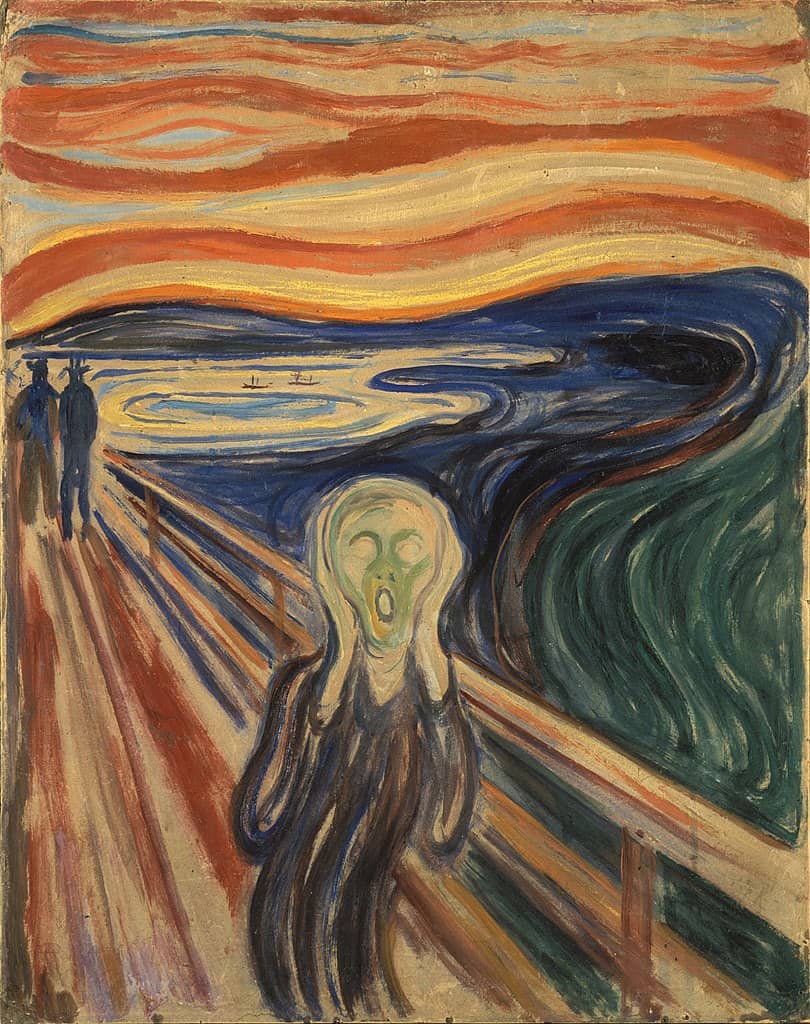
Munch, Edvard. The Scream. 1893.

Leave a comment