
The following is an interview with Dr. Adrianne Honnold, an ethnomusicolgy professor at Lewis University. Her book The Legacy of Elise Hall: Contemporary Perspectives on Gender and the Saxophone is available here online for free.
The role of establishing one’s unique sonic profile
That’s something that is really important to a lot of jazz musicians and, popular musicians as well. I mean, like Billie Eilish, when she first came on the scene, she kind of didn’t sound like a lot of other people. And so that has ended up setting her apart from a lot of other young women pop stars.Or, you hear Lady Gaga and you can recognize that it’s Lady Gaga or, you know, people millions of people all over the world recognize Beyonce’s voice, or Ozzy Osbourne.
All these different people from different genres, and [sounding unique] is something that’s really prized in those genres. Jazz is very much that way. People like my husband and I —he’s also a professional saxophonist— we can go to a gig and hear a saxophonist, and we know who that person’s been listening to because their sound then kind of sounds like Coltrane or Michael Brecker, you know, or Charlie Parker.
The effect the saxophone has had on popular music
It is not so obvious anymore, but, [the saxophone] was absolutely one of the early pillars or foundations of popular music as we know it today. And this is one of the areas of my my own personal expertise. I teach about this all the time.
I can talk about one person as, like, a case study that kind of represents this? So Louie Jordan, he’s kind of a deep dive. He was a saxophonist, and he was a jazz saxophonist. And he was really active during the swing era—World War two and the nineteen thirties and then into the World War two era. He played with a guy named Chick Webb; totally legit jazz band back in the day. And he decided basically that he wanted to play music that was more for the people, for dancing.
And so he made a conscious decision to kind of leave jazz specifically and go much more into, like, a popular route. But he took, of course, his saxophone with him, And he was a band leader. He basically was just playing band, dance music that really kind of sounded like jazz, but it almost it started to sound like something else. They call his style now jump blues. He was one of the main people that helped rock and roll happen in the nineteen fifties.
That’s important because that’s when the music industry sort of developed as we know it now is with the advent of rock and roll in the nineteen fifties. His Louis Jordan’s record producer went on to produce records for, Bill Haley and the Comets—often considered, like, one of the first rock and roll stars— and several other people. So, he was, like, the sound architect, and he was coming from working with Louis Jordan. So that’s, like, one way that we can see how jazz crossed over. Also, the saxophone was really prevalent in early rock and roll, and so that was a clear connection between jazz and popular music in the nineteen fifties.
And then just the the sheer fact that there’s small improvisations in a lot of rock music or pop music; that comes from jazz. We don’t see the guitar solo as much as we used to, like in the seventies or eighties or —saxophone solo for that matter—but, anytime there’s a bit of improvisation or a section in the middle of a pop song, it’s coming from the jazz realm.
The history of the saxophone
The patents for the instrument [saxophone] was in 1846. Adolphe Sax was a Belgian, but he was living in France, in Paris at the time, and it just couldn’t find a place. He invented this thing. He also invented a bunch of other instruments you might be familiar with, like the tuba as we know it today and the bass clarinet. He was pretty active in that world of instrument invention and tweaking. But he was also trying to be a salesperson and go out and get people to buy the instrument so it would actually go somewhere and people would play it and hear it.
And his first sales of the instrument in bulk was to a French military band. So saxophone has its roots in military bands. It immediately started to spread around the world because those people in those military bands started going around and playing concerts everywhere. It was very exotic, and they kind of played on that because it was this new instrument. But the French military bands before the saxophone had a bunch of oboes. We can kind of laugh now if we’re familiar with what a marching band sounds like. It’s loud, right? And can you imagine an oboe? That just gets drowned out nowadays.
The French military band sounded really small. The adoption of the saxophone, in fact, they put four saxophone players in there, and it increased. It made the band sound bigger, and the sound spread across the big fields outside where they were performing. So it was successful. It came over here to The United States through the military bands, and we in The US started putting it in our military bands.
And then there were actually several women that adopted the instrument very early on that people kind of don’t know about. The first person ever mentioned to play the saxophone as a solo instrument in a classical way was a woman named Bessie Mecklem, and she was in the New York Times. I think that was in the eighteen eighties, if I remember correctly. Basically, people didn’t quite understand what to do with it. Then right when it started to spread in popularity was here in The US when jazz and popular music were starting.
The Saxophone Craze
The music industry itself was building up in the nineteen teens and twenties and jazz. It finally found its place, and it exploded. It exploded. We actually refer to it now as the saxophone craze, and it happened in the nineteen twenties. A bunch of American saxophone manufacturers popped up, and they were making 300,000 instruments a year per company. They were selling them. That’s the thing. They weren’t just making them. People were buying them. It went through a huge craze, and that is partially because of the popularity of jazz music at the time, it was the jazz age. The nineteen twenties and other popular music, Tin Pan Alley. It lent itself to all these genres. It was also not that expensive.
It coincided with the advent of the mass media industry in The United States. You can actually go back and find newspaper clippings of saxophone ads all over the place in every magazine. It’s wild. And that was all at the same time. But so classical saxophone was always there, and that’s how it got started.
That’s what Adolphe Sax wanted it to be. He thought it would be a classical instrument. One of the very first people that started getting composers to write for it was Elise Hall. I co-edited a book about her. She was a super wealthy white woman living in Boston, and she used her money to pay Claude Debussy, for instance, to write music for the saxophone because we didn’t have any music.
All the music we had was just pedagogy stuff, like Etude books, and it was all based on clarinet and flute mostly. It took several years. They started writing classical things specifically for the saxophone, but it took a while. It was kind of a novelty, and that’s why people thought it fit very well with jazz and pop when jazz and pop were relatively new in the 1910s, teens and twenties. It just felt like a novelty, and it can do all kinds of weird things. Like, you can make a saxophone laugh. You can do the slap tongue. You can do, like, these moaning sounds. And so people kind of, like, just did that.
So it still has sometimes that those, reputation to some degree of, like, a comic relief. But, nowadays, there are, I don’t have the exact number, but there’s something like over 5,000 works written for Symphony Orchestra with saxophone. And people just don’t necessarily know that; but it’s becoming much more of a thing. So we have quite a bit of repertoire.
It’s mostly from mid-century. A lot of our early stuff is from the thirties and forties. Have you ever heard of Paul Creston, American composer? Around 1970, the classical saxophone repertoire started to shift, and it became much more unique to the saxophone. Nobody else can play most of our music, our classical music since the seventies.
It’s very unique to the saxophone. Whereas before that, throughout the twentieth century, [classical music] could be flute music, could be clarinet music, could be oboe music. I think we’re all still figuring out what it can do. It’s pretty versatile.
Elise Hall and early classical saxophone music
[Elise Hall] was a socialite. She had family money and in, 1898, I believe, or late eighteen hundreds, her husband died. And so she was just independently wealthy. He, he was a doctor.
He was a medical —a physician— and, a lot of people for many years thought that it was his money that she was spending, but it wasn’t. Actually, it was always her money. Her maiden name is Coolidge —she was actually related to the president Calvin Coolidge. She’s East Coast elite, generational wealth.
It’s so interesting because there was this trend in the late eighteen hundreds of a lot of doctors and people just out in the world saying: “Hey! You should play a wind instrument. It’s good for your health.” They trying to come up with ways for people to be active or to find things that they enjoy doing in life. And one of those was wind instruments, and they, literally, doctors were prescribing it to people, which is kind of interesting.
We don’t have any of her personal letters or notes to confirm this, but the general thinking is that she went along with that trend at the time. She found this instrument, the saxophone. She took some lessons with a guy in California when she was living there, and then she moved back to Boston after her husband died. She ended up spending her money as a patron. She ended up paying composers to write music that she could perform. She commissioned 22 works, different pieces. She even started her own something called the Boston Orchestral Club so she could perform the works with her friends and with the professional musicians in Boston at the time. She became quite good. She was super well reviewed in all the local newspapers in Boston and in Paris as well.
She used to travel back and forth between Europe a lot. She was technically born in Paris, even though she was her family was from Boston. The reason we have a piece called the rhapsody for saxophone orchestra by Debussy is is her. Her name is right on the on the front page. And then some other French composers.
She was basically going down the list of composers that won something called the Prix de Rome. It’s just called the Rome prize, and it’s very prestigious for composers. It’s a global thing and it’s been around for a long, long time. But she was literally just going down the list of the Prix de Rome and asking those composers to write music for saxophone.
So in her own way, she was establishing the classical saxophone repertoire as we know it today. And in fact, one of the composers that wrote a piece for her, He wrote the very first concerto for saxophone and orchestra. His name it looks like Paul Gilson, but it’s pronounced zhēl-sôn because he was French speaking Belgian person. He wrote the very first concerto; that was 1902-1903. I I’d have to look it up, but early twentieth century.
Representation in music
It’s so interesting that a lot of the first people to play the saxophone were women, and yet, around the nineteen twenties and thirties, they started to kind of write those people out of the histories.
That’s part of the work that I’m dedicated to doing throughout my life. I absolutely think that if we were able to see more of all the different kinds of people that were playing it, there would be a wider variety. It’s already better than it used to be with saxophone, but something we talk about in our organization, which is called the North American Saxophone Alliance, and yes, it is NASA, but not the space one, is that, for instance, when I started in fifth grade, it was pretty equal, boys and girls playing the saxophone. Then as the years went on, the other girls kind of quit or I don’t know where they went.
I don’t know what happened, but then I was the only one. And in most of my professional career, I was the only one. And that’s not as common now. You see all different kinds of people. But, part of the reason I went to the University of Illinois to study saxophone was because of professor, Deborah Richtmeyer, who’s one of the very first women to be featured at a World Saxophone Congress, to be featured in these performances.
And so I was like: “she’s awesome. I wanna go study with her”. I’m writing a new book, with some people, and it’s about black women’s saxophonists in the early twentieth century.
And one of our coauthors, her name is, Dr. Wheeler, and she teaches at Louisiana State University. She’s one of the only black women classical saxophonists that we have right now. She’s gonna be exploring that topic even more. But there were all these during the saxophone craze, there were a huge number of women and also women of color playing the saxophone, but we just don’t even know about them.
We wanna not only, like, bring that bring some attention to the people that were doing it, but also talk about how that was normal and what happened since then? Why don’t we know about it now?
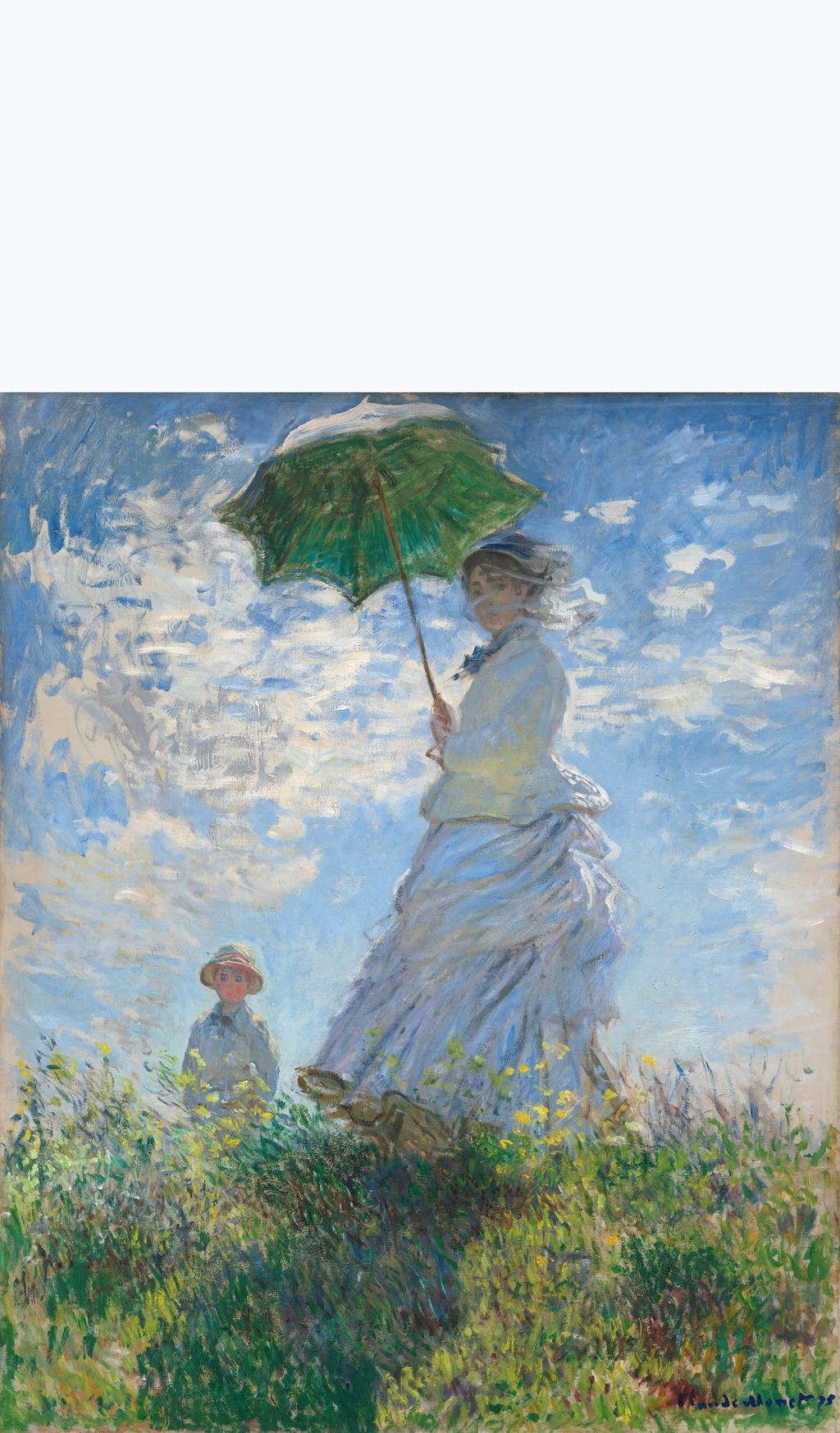
Monet, C. (1875). Woman with a Parasol – Madame Monet and Her Son [Oil on canvas]. National Gallery of Art, Washington, D.C., United States.

Leave a comment