Similar to my last commentary, I’ll be exploring in depth the influence of classical music on pop. However this time my focus is on a unique style of music, commonly known as a mashup.
Funnily enough, my first exposure to the style was through YouTube with a mashup between Smash Mouth’s All Star and Ed Sheeran’s Shape of You—however the mashup genre includes the huge scene of DJs and remix artists.
The science behind mashups is relatively simple. Pop songs often rely on the same diatonic major scale, simple four-bar phrase structures, and cyclic chord progressions, which allow different tracks to merge without harmonic conflict. Even when chord progressions differ, such as All Star compared to Shape of You, the flexibility of the major scale ensures that musical elements can be recombined smoothly.
The practice of pairing songs together has a long history. The technical name for it, in Latin, is quodlibet—the practice of combining two or more popular songs into one. While the word goes back to the 13th century, the practice became really popular in the 16th century with the advent of the parody mass. Composers would weave in sections of fairly lewd popular secular songs into the middle of the sacred Catholic mass. Johann Sebastian Bach also wrote a quodlibet as the 30th and final variation of the Goldberg Variations. His family was known for harmonizing popular tunes together within the same harmonic framework, sometimes using very “dirty” songs of the era. One of the most famous moments came when Charlie Parker interpolated the opening of Stravinsky’s Firebird into a performance, prompting Stravinsky himself—present in the audience—to roar with delight.
Simultaneous melodies have also been a staple in opera and musical theater. In the movie Amadeus, there’s a scene where Mozart describes how all of this comes together in his opera, The Marriage of Figaro, “In a play, if more than one person speaks at the same time, it’s just noise. No one can understand a word. But with opera, with music. With music, you could have twenty individuals all talking at the same time, and it’s not noise – it’s a perfect harmony.”
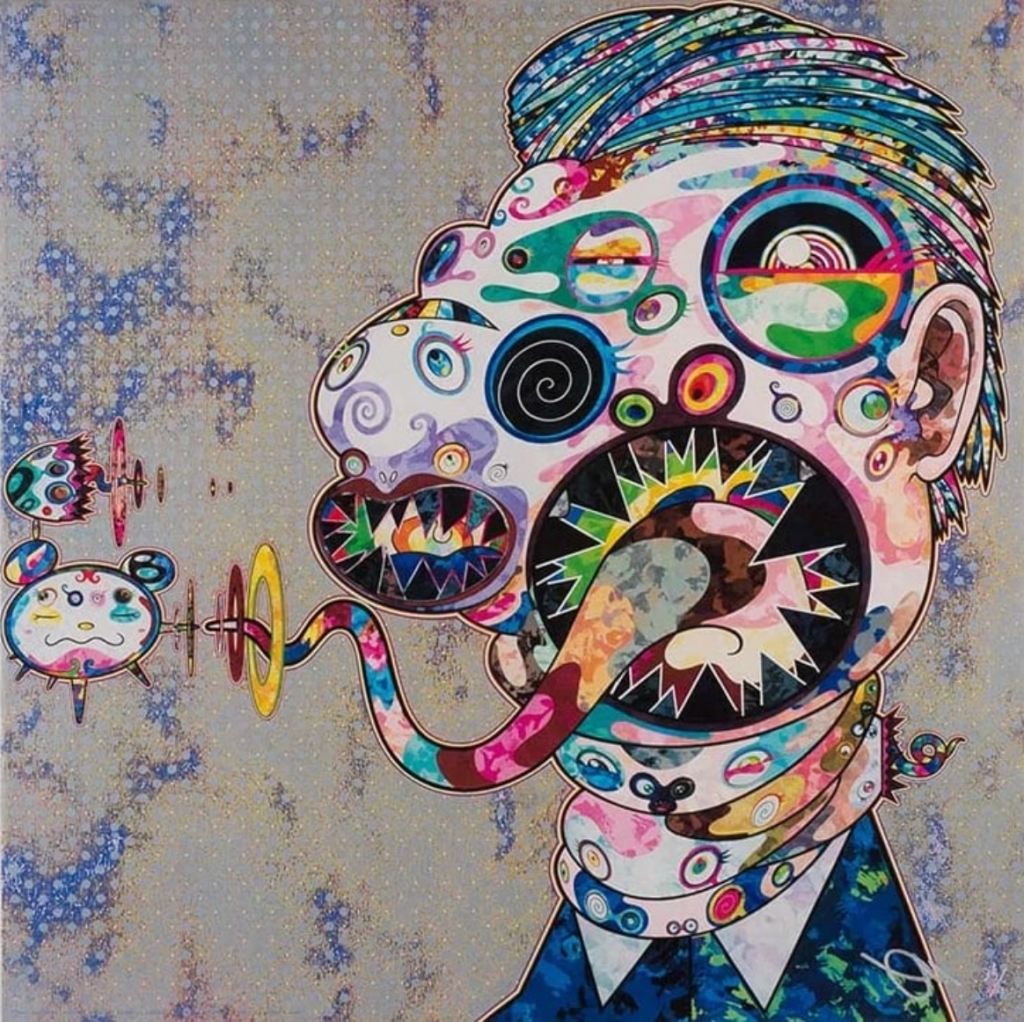
Murakami, Takashi, An Homage to Francis Bacon (Study for Head of George Dyer, Moiré), 2016, offset lithograph, 73.7 × 73.7 cm

Leave a comment