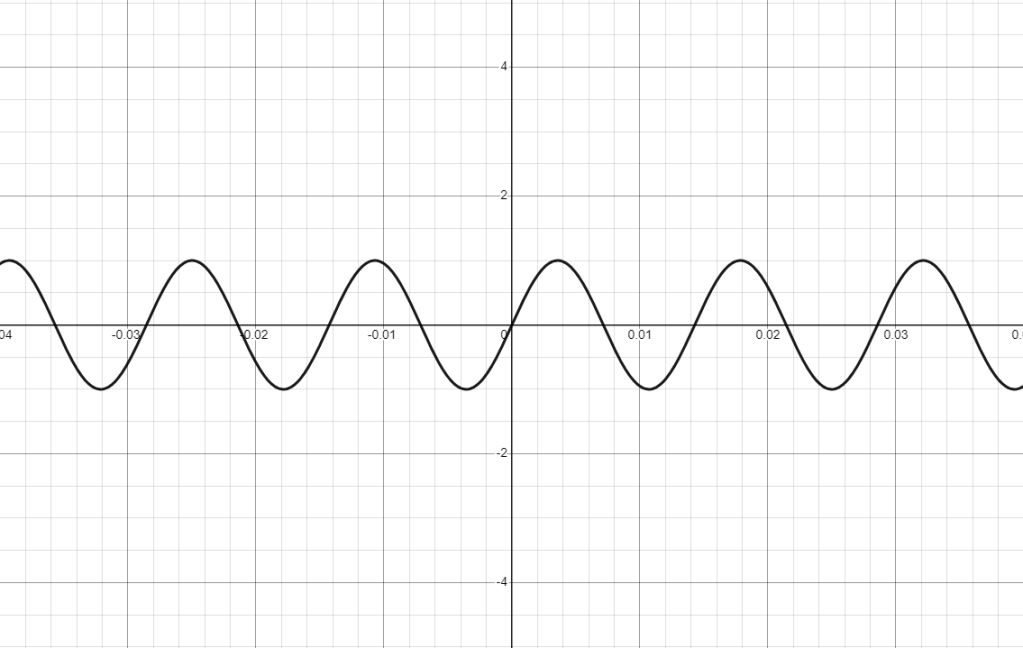
It is generally considered that when tuning one’s instrument to tune the note A4 (“A” in the fourth octave) to 440Hz. Western music is based on the 12 notes in the chromatic scale (A, A#, B, C, C#, D, D#, E, F, F#, G, G#) with each note being assigned a frequency. Each notes also has multiple octaves: an A3 would be 220Hz (half of 440Hz), A5 would be (880Hz), and so on.
Sound is a wave, and the frequency is determined by wavelengths per second. Wavelengths are generally measured with the metric measurement for length, the meter. The meter was determined by splitting up the distance between the equator and the north pole into a million pieces, each piece being one meter. The second was determined by taking the period of earth’s orbit, dividing it by its rotation, dividing that by 24 hours, then 60 minutes, then finally dividing it into 60 seconds. Scientists have since determined that to be equal to be 9,192,631,770 periods of radiation of a caesium-133 atom. Even though math and science is generally considered universal, these measurements have semi arbitrary roots, why split the length from the north pole to the equator into a million pieces, not two million? Why not 10 hours in a day? This is all to say that as much as humans want them to, the measurement we make in order to model the universe are not universal.
There have been unfounded theories that listening to music tuned with notes based on 432Hz will provide health benefits to the listener. This is supposedly because 432Hz is a “natural” frequency, but because the unit of hertz itself is man-made and artificial, this is immediately disprovable. The origination of 432Hz as “A” stems from scientific pitch, created by physicist Joseph Sauveur, where C-4 is 1Hz, and the rest of the notes were built from the octaves of C (1Hz, 2Hz, 4Hz…). A4 is 430.54Hz when using this system, but was commonly rounded to 432Hz. There is nothing wrong with tuning to 432Hz than to 440Hz, it provides a different sound that might be preferable, but there are no universally innate properties that note has.
It is undoubtedly interesting that people want to try and make music more mathematical, yet it never seemed to catch on. This is because tuning A4 to 440Hz has been made to sound better and sound more “normal” to people. Simply because we are used to this tuning system in western music, we use it. There is no other explanation. Tuning to 432Hz doesn’t sound bad, but it does sound different, but in a world where formulaic pop music is put into people’s ears, it can seem foolish to stride away from a system that works.
Having a system that encourages formulaic production makes it very difficult to be successful while also being unique. This problem is not a recent problem, bands and artists have been “selling out” for generations, but it can be solved. With the rise of music streaming and social media, it is becoming increasingly easier to find people who share your niches. Musicians are able to use these platforms to promote their music and get people exposed to music that they would not normally come across. Instagram and Tiktok allow musicians to create short videos that can get exposed to thousands of users. New and creative content often can thrive on these platforms, and can encourage musicians to think creatively.
Creativity with music benefits everyone. Listeners can find music they connect with while artists and share their unfiltered and genuine feelings. Innovation only increases the capacity for music to be created, reach people, and affect people.


Leave a comment